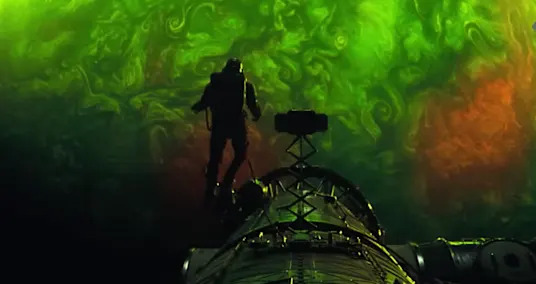
MOSCOW (Reuters) -A Russian Soyuz MS-28 spacecraft with two Russian cosmonauts and one NASA astronaut on board successfully docked with the International Space Station on Thursday, Russian space agency Roscosmos said.
But the agency later reported that the launch pad at the Baikonur Cosmodrome in Kazakhstan had sustained damage from the launch. It said the damage would be quickly repaired.
The Soyuz 2.1a rocket lifted off from the Baikonur Cosmodrome at 12:28 p.m. Moscow time (0928 GMT).
Late on Thursday, Russian news agencies quoted Roscosmos as saying the launch had taken place without incident, but damage was observed after an inspection of the launch area.
"Damage to a number of elements of the launch pad was detected. An assessment of the state of the launch complex is being conducted now," the agencies quoted Roscosmos as saying.
"All the necessary reserve elements are there to restore it and the damage will be eliminated very soon."
It said the crew was on board the station and in good health.
(Reporting by Anastasia Lyrchikova; Writing by Marina Bobrova; Editing by Andrew Osborn, Ron Popeski and Bill Berkrot)
LATEST POSTS
- 1
 5 Cell phones of the Year
 - 2Australia Cracks Down on Gambling Ads as Prediction Markets Like Polymarket Remain Blocked
- 3Porsche May Kill the Electric Boxster Before It Ever Arrives
- 46 Home Cleaning Administrations to Keep Your Home Unblemished
- 5Is relief in sight? Flu season still brutal but cases are declining.



- Nodding off is dangerous. Some animals have evolved extreme ways to sleep in precarious environments
- Judge sets $60K bond for Florida congresswoman accused of stealing $5M in COVID-19 funds
- I'm a hypnotherapist who helps day traders who are losing money. Here's why I think hypnosis works.
- Scientists detect X-ray glow from interstellar comet 3I/ATLAS extending 250,000 miles into space
- Lahav 433 head Asst.-Ch. Meni Benjamin named as police officer investigated for breach of trust
- Where should we send a real 'Hail Mary' spacecraft? A new study has the answers
- Step by step instructions to Boost the Eco-friendliness of Your Smash 1500.
- The race is on to turn your body into a GLP-1 factory
- Netflix is releasing a documentary on Elizabeth Smart. What to know about her kidnapping, rescue and where she is now.